
There is a specific moment that every TRT and hormone clinic owner eventually reaches. The ads are running. The leads are coming in. The phone is ringing. And somehow, the revenue is not where it should be.
The leads are not bad. The clinical offer is strong. The pricing is competitive. But somewhere between the lead opting in and the patient committing to a care plan, something is breaking. Consultations are being missed. Follow-up is inconsistent. Patients who seemed interested on the call are not converting. The clinic is generating real interest and not capturing the revenue that interest represents.
In almost every case, the root cause is the same: there is no dedicated person whose job is to handle the sales process.
This post is about how to fix that. Specifically, how to find the right person, what to look for in a candidate, where to source them, how to structure the role, and how to train them to close premium annual care plans for a hormone clinic. This is not a surface-level overview. This is the actual playbook for building the intake function that turns your marketing investment into predictable revenue.
Why Your Clinical Staff Cannot Do This Job
Before getting into the hiring process, it is worth being direct about something that most clinic owners resist hearing: your clinical staff, your front desk, your nurses, your PAs, and your physicians are not the right people to handle the sales function in your clinic. Not because they are not capable people, but because the job requires a completely different skill set and a completely different mindset.
Clinical professionals are trained to be thorough, cautious, and patient-centered in a way that prioritizes information delivery over decision facilitation. That is exactly what you want from the people treating your patients. It is the opposite of what you need from the person whose job is to guide a prospect through a financial commitment.
Closing a patient on a $2,400 to $3,600 annual hormone care plan requires the ability to create urgency without pressure, handle financial objections without backing down, present a premium offer with confidence, and guide a hesitant prospect toward a decision that is genuinely in their interest. These are learned sales skills. They are not instinctive for most people, and they are almost never part of clinical training.
When you ask your front desk to handle intake calls alongside their other responsibilities, you are setting them up to fail and leaving significant revenue on the table. The solution is to hire someone whose entire job is this one function.
What the Role Actually Is
A patient intake specialist for a TRT or hormone clinic is not a receptionist. They are not a patient coordinator in the traditional sense. They are a sales professional who operates inside a medical business.
Their job has three components.
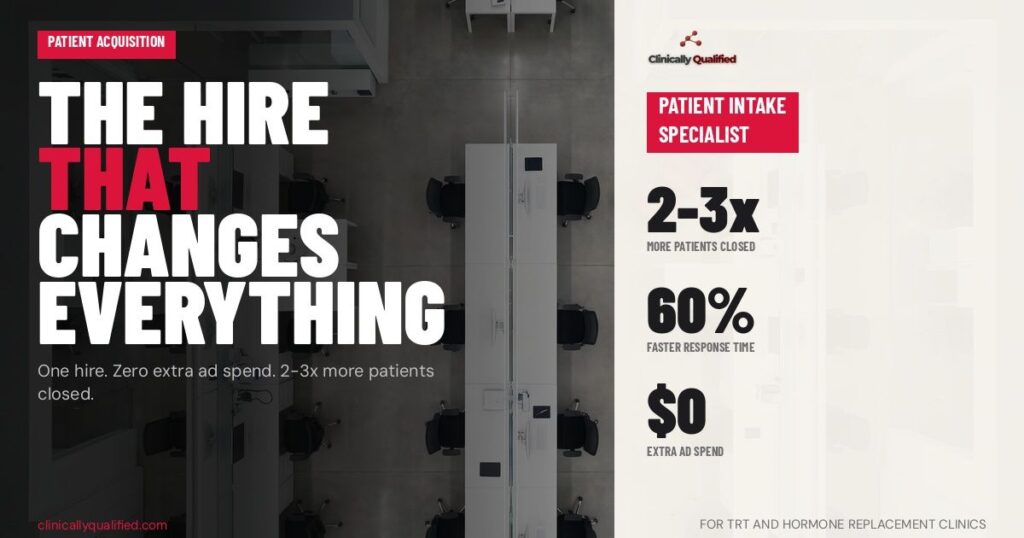
First, they handle all inbound lead follow-up. Every person who fills out a form, watches the VSL, or responds to an ad gets contacted by the intake specialist within minutes. Not hours. Minutes. The research on lead response time in medical practices is unambiguous: the probability of converting a lead drops by more than 80 percent if the first contact happens more than five minutes after the opt-in. The intake specialist's job is to be the first human voice a prospect hears, and to be that voice fast.
Second, they conduct all consultation calls. This is not a clinical consultation. It is a sales conversation structured around understanding the patient's situation, presenting the clinic's care model, handling objections, and closing the patient on a commitment to move forward. The intake specialist needs to be able to discuss hormone health at a high enough level to be credible, but their primary skill is not clinical knowledge. It is the ability to guide a conversation toward a decision.
Third, they manage the follow-up pipeline. Not every prospect converts on the first call. A significant percentage of your leads are genuinely interested but not ready to commit immediately. The intake specialist is responsible for maintaining contact with those prospects, delivering value through follow-up content, and re-engaging them when the timing is right. This is where a lot of clinics lose patients they should have closed: the prospect says "I need to think about it" and nobody ever follows up.
Where to Find the Right Candidates
The best intake specialists for hormone clinics come from specific sales backgrounds. Here is where to look and what to prioritize.
High-ticket health and wellness sales. Anyone who has sold premium health programs, functional medicine packages, weight loss protocols, or similar high-ticket health offers already understands the emotional dynamics of selling a health transformation. They know how to handle the "is this really worth it" objection. They understand that the financial conversation in health is different from the financial conversation in software or real estate. This is the most transferable background.
Medical device or pharmaceutical sales. These candidates understand the clinical vocabulary, are comfortable in medical environments, and are accustomed to building relationships with healthcare professionals. The transition to patient-facing sales requires some adjustment, but the credibility and clinical literacy they bring is valuable.
Fitness and personal training sales. High-volume gym sales environments produce people who are comfortable with daily rejection, skilled at creating urgency, and experienced at selling health transformations to skeptical buyers. The best gym sales professionals are genuinely talented closers who are often undervalued in their current roles.
Online sales communities and groups. The most efficient place to source candidates right now is inside sales-specific communities on Facebook and LinkedIn. Groups like "Sales Professionals," "Remote Sales Jobs," "High Ticket Sales Closers," and similar communities have thousands of active members who are specifically looking for commission-based or salary-plus-commission sales roles. Posting a detailed job description in these groups will generate applications from people who are actively in sales and looking for the right opportunity.
LinkedIn direct outreach. Search for candidates with titles like "Patient Coordinator," "Health Sales Consultant," "Wellness Sales Specialist," or "Inside Sales Representative" in the health and wellness space. Filter by location if you need someone on-site, or leave it open if the role can be conducted remotely. Send a direct message that describes the role specifically, including the compensation structure and what makes the opportunity compelling.
Job boards with sales-specific filters. Indeed, ZipRecruiter, and LinkedIn Jobs all allow you to filter by sales experience and industry. Post the role with a clear title that attracts the right candidates: "Patient Intake Specialist for Premium Hormone Clinic" or "Health Sales Consultant for TRT and Hormone Optimization Clinic." Be specific about the compensation structure in the posting, because sales professionals evaluate opportunities primarily on earning potential.
What to Look for in the Interview
The interview process for an intake specialist should include a live role play. This is non-negotiable. You can learn almost nothing about a person's ability to close from a resume or a standard interview. You learn everything from watching them handle a simulated consultation call.
Give the candidate a brief scenario: they are calling a prospect who filled out a form expressing interest in hormone optimization, the prospect has watched the VSL, and they are now on a consultation call. Tell the candidate to run the call as they would naturally. Then watch for the following.
Do they ask good discovery questions before presenting the offer? A skilled closer does not pitch immediately. They ask questions that uncover the prospect's specific situation, their symptoms, their frustrations, their goals, and their timeline. This discovery process serves two purposes: it gives the closer the information they need to present the offer in the most relevant way, and it gets the prospect talking about their own pain, which creates emotional investment in the solution.
How do they handle the price objection? At some point in the role play, introduce a price objection: "That's more than I was expecting to spend." Watch how the candidate responds. A weak candidate apologizes or immediately offers a discount. A strong candidate acknowledges the concern, reframes the value, and uses the objection as an opportunity to reinforce the commitment. They might say something like: "I understand that. Can I ask what you were expecting? Because I want to make sure we're comparing the right things. What you're investing in here is not a monthly subscription that you can cancel when life gets busy. It is a full year of dedicated hormone care with a team that is accountable to your results."
Do they ask for the commitment? The most common failure mode in sales calls is that the conversation goes well and then nobody asks for the close. The prospect says "this sounds great" and the caller says "great, I'll send you some information." The deal dies. A strong intake specialist knows how to transition from a positive conversation to a direct ask: "Based on everything you've shared, it sounds like this is exactly what you've been looking for. I have availability on the calendar starting next week. Should we get you enrolled today?"
How to Structure the Compensation
The compensation structure for an intake specialist should be designed to align their incentives with your revenue goals. The most effective structure for this role is a base salary plus commission on closed patients.
A reasonable base for a full-time intake specialist is in the range of $35,000 to $50,000 annually, depending on the market and the candidate's experience level. Commission should be structured as a percentage of the collected upfront payment on each new patient enrollment. A commission rate of 5 to 10 percent on a $2,800 average upfront collection means the specialist earns $140 to $280 per closed patient. At 15 to 20 new patients per month, that is $2,100 to $5,600 in monthly commission on top of their base salary.
This structure creates a genuine earning opportunity for a talented closer, which is what attracts the best candidates. It also ensures that your intake specialist is motivated to close every qualified patient, not just the easy ones.
Be transparent about the earning potential in your job posting and in the interview. Sales professionals are evaluating your opportunity against other options, and a clear picture of realistic earnings is one of the most compelling things you can offer.
How to Train Them for the Hormone Clinic Context
Even a highly skilled sales professional needs specific training to perform in the hormone clinic context. The clinical vocabulary, the patient psychology, the specific objections that come up in hormone conversations, and the structure of your particular offer all need to be part of their onboarding.
The training should cover the following areas.
Clinical literacy. The intake specialist does not need to be a medical professional, but they need to be able to speak credibly about the symptoms of hormonal imbalance, the basics of how hormone optimization works, the difference between your concierge model and telehealth alternatives, and what patients can realistically expect from treatment. This credibility is essential for building trust on the consultation call. A patient who senses that the person they are speaking to does not actually understand what they are selling will not commit.
The specific objections in this space. Hormone optimization has a set of objections that come up consistently: "I'm not sure if I actually need this," "I've heard there are side effects," "I want to try some lifestyle changes first," "I need to talk to my wife about the cost," "I've heard about Hims and Ro and they're a lot cheaper." Your intake specialist needs a prepared, confident, and honest response to each of these. These responses should be scripted initially and then internalized through practice until they feel natural.
Your offer structure. The specialist needs to understand exactly what is included in each care plan, what the financial commitment looks like, what the financing options are, and how to present the annual upfront model in a way that makes it feel like the obvious choice rather than a financial burden.
The CQ Sales Academy is a resource specifically designed to train intake specialists and sales professionals in the hormone clinic context. If you want a structured training program that covers the full consultation call framework, objection handling, and closing techniques specific to this space, it is the most efficient way to get a new hire performing at a high level quickly.
You can also see real intake specialist calls in action, including how top performers handle the most common objections and close patients on premium annual plans, at the link below.
The Alternative: Let CQ Place the Specialist for You
Building this function from scratch takes time. Sourcing candidates, interviewing, training, and managing the ramp-up period while your marketing is running is a significant operational lift. For many clinic owners, the faster path is to have a trained specialist placed directly into their business by a team that has already done the work of finding, vetting, and training the right people.
This is one of the core components of what Clinically Qualified does for the TRT and hormone clinics we work with. We do not just run ads and hand you leads. We place a dedicated intake specialist into your clinic who is already trained on the hormone patient journey, already knows how to present premium annual care plans, and is ready to handle your consultation calls from day one.
If you want to see how the full system works, including the ads, the funnel, the follow-up automation, and the intake specialist placement, the link below is where to start.
The intake function is not a nice-to-have. It is the single highest-leverage hire in a hormone clinic's growth stack. Get it right and everything else in your marketing system performs at the level it is supposed to.