
The average hormone clinic follows up with an unconverted lead twice. Maybe three times. Then they move on, write off the ad spend, and hope the next batch of leads converts better. This is one of the most expensive habits in the industry.
The data on lead conversion tells a different story. A significant percentage of leads who do not book in the first 48 hours will book within 30 to 90 days if they are engaged with the right sequence. The problem is not that these leads are uninterested. The problem is that they are not ready yet, and most clinics stop communicating with them before they get there.
Understanding Why Leads Go Cold
A man who fills out a form or clicks on an ad is expressing interest, not commitment. He may be in the early stages of research. He may have gotten busy. He may have had a conversation with his wife that gave him pause. He may have seen your ad, filled out the form, and then gotten pulled away before he could book. In none of these cases is he a dead lead. He is a lead at a different stage of the decision process.
The clinics that recover these leads understand this. They do not treat a non-response as a rejection. They treat it as a signal that the prospect needs more time and more information, and they build a sequence designed to provide both.
The Anatomy of an Effective Follow-Up Sequence
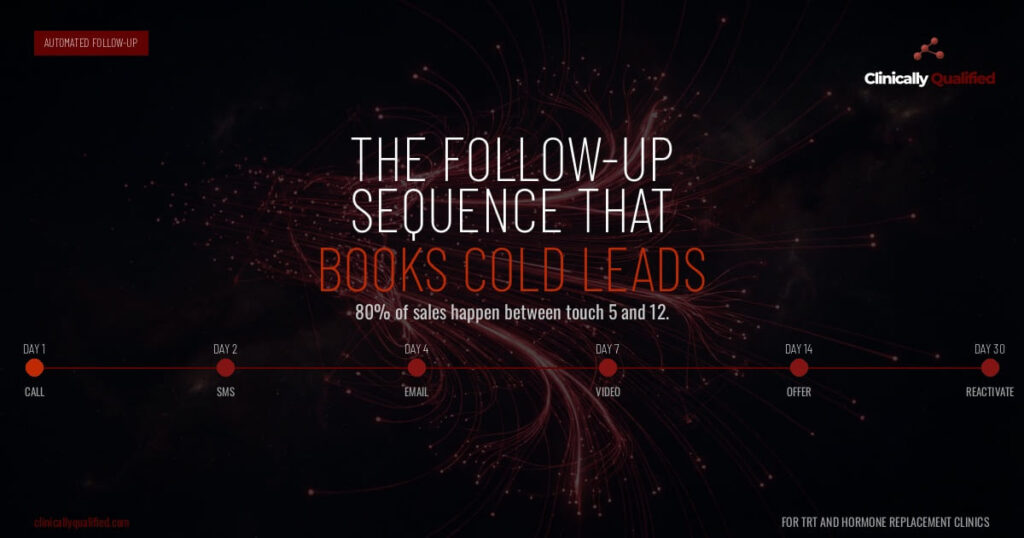
Day 1 — Immediate Response: The first contact happens within five minutes of the lead coming in. This is non-negotiable. Research consistently shows that the probability of connecting with a lead drops dramatically after the first hour. The first message is a call, followed immediately by a text if there is no answer. The text is short, specific, and personal: it references what the prospect expressed interest in and offers a clear, low-friction next step.
Day 2 — Value Touch: The second contact is not another attempt to book. It is a piece of value — an educational message, a short video, or a relevant piece of content that addresses a question the prospect is likely asking. This positions the clinic as a resource rather than a sales operation and keeps the conversation open without pressure.
Day 4 — Social Proof: By day four, the prospect has had time to think. The day-four message delivers social proof — a patient story, a testimonial, or a specific outcome that a man in a similar situation achieved. This is not a pitch. It is evidence.
Day 7 — The Direct Ask: A week after the initial inquiry, the sequence makes a direct, confident ask. Not "just checking in" — that phrase signals desperation and adds no value. Instead, a specific offer: "I have a spot available this week for a consultation. Would Tuesday or Thursday work better for you?" Specificity creates response.
Day 14 — The Reframe: Two weeks in, the message shifts. Instead of continuing to pitch the consultation, it addresses the most common objection directly. For hormone clinics, this is usually cost or skepticism about results. A message that acknowledges the hesitation and provides a clear, honest response to it will often unlock leads that have been sitting on the fence.
Day 30 — The Long Game: A month after the initial inquiry, most clinics have completely forgotten about this lead. The ones that have not send a final value-based message — a piece of content, a relevant update, or a simple check-in that keeps the clinic top of mind. Many leads that convert at the 30-day mark do so because they received this message at exactly the moment they were ready to move.
80% of sales happen between the fifth and twelfth contact. Most clinics never make it past the third. The follow-up sequence is not a nice-to-have. It is the difference between a 15% conversion rate and a 35% conversion rate on the same leads.
What the Sequence Is Not
The follow-up sequence is not spam. It is not a daily barrage of messages that erode trust and generate opt-outs. It is a carefully timed, value-first series of contacts that respects the prospect's timeline while keeping the clinic present and credible.
The tone throughout is confident and helpful, never desperate. The clinic is not chasing the lead. It is making itself available to a man who expressed interest and may simply need more time.
Building the Sequence
The most effective follow-up sequences use a combination of channels: phone calls for the first two to three contacts, SMS for shorter value touches, and email for longer-form content. The channel mix matters because different men respond to different channels, and a multi-channel approach ensures that the message gets through.
The content of each message should be written once and automated. This is not a manual process. A clinic whose follow-up depends on a staff member remembering to send a text will have inconsistent results. A clinic whose follow-up is automated will have consistent results — and consistent results compound over time into a patient acquisition engine that runs without daily attention.